
Automotive Chemical Product Compliance: SDS and Labeling Requirements for Car Care Brands
By The Compounded Compliance Chemistry Department
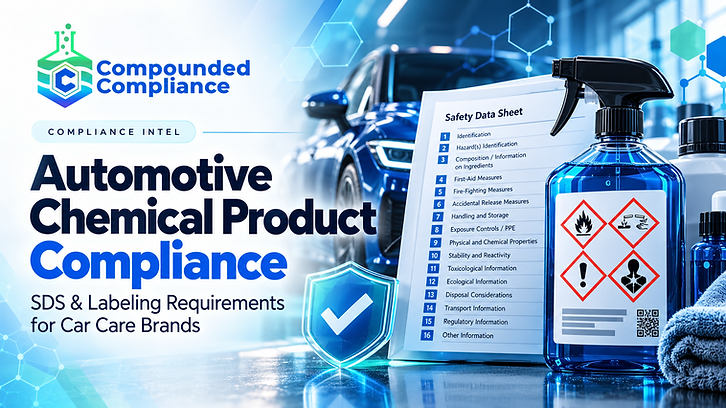
If you manufacture car care products, detail sprays, degreasers, ceramic coatings, wheel cleaners, or waxes, you are producing hazardous chemical products. That means you need safety data sheets and GHS-compliant labels for every product you ship. Many car care brands learn this the hard way, after a retailer flags a missing SDS or a distributor rejects a shipment because the label is incomplete.
This article walks through what you need to know about SDS authoring and GHS labeling specifically for automotive chemical products, and how to build a process that keeps you compliant as your product line grows.
Which Automotive Chemical Products Require an SDS
Under the OSHA Hazard Communication Standard (29 CFR 1910.1200), any chemical product that poses a physical or health hazard requires a safety data sheet. For car care brands, that covers the vast majority of the product catalog:
- Detail sprays and quick detailers may contain solvents or surfactants that cause skin or eye irritation
- Degreasers and all-purpose cleaners often include alkaline or acidic ingredients that are corrosive or toxic
- Ceramic coatings and sealants may contain flammable solvents or chemicals with acute toxicity
- Wheel cleaners frequently use acidic or corrosive formulations
- Waxes and polishes may contain volatile organic compounds and flammable solvents
- Fuel additives and performance fluids typically have flammability and toxicity hazards
Even products marketed as "green," "bio-based," or "non-toxic" can require an SDS if they contain ingredients that meet any GHS hazard classification criteria. The marketing label does not determine whether you need an SDS. The hazard classification does.
How to Classify Automotive Chemical Hazards
Hazard classification is the foundation of both the SDS and the label. You must evaluate each product against the GHS hazard classes defined in OSHA's Appendix A and Appendix B. The most common hazard classes for automotive chemical products include:
- Flammable liquids (Category 1-4): Products containing solvents like isopropyl alcohol, naphtha, or mineral spirits
- Skin corrosion or irritation (Category 1-2): Alkaline degreasers, acidic wheel cleaners, and concentrated surfactants
- Serious eye damage or eye irritation (Category 1 or 2): Many cleaning products, especially in concentrate form
- Acute toxicity (Categories 1-5): Oral, dermal, and inhalation routes for products with toxic ingredients
- Specific target organ toxicity (single or repeated exposure): Products containing solvents that affect the central nervous system, liver, or kidneys
- Hazardous to the aquatic environment: Many automotive chemicals contain ingredients that are toxic to aquatic life
Classification is not optional and it is not a guess. It requires reviewing the formulation ingredient by ingredient, understanding concentration thresholds, and applying the classification criteria methodically. If you are unsure whether a product meets a hazard class, you should consult a qualified chemist or compliance specialist rather than leaving it blank.
The Six Required Label Elements
Every shipped container of a hazardous chemical product must carry a label with six specific elements. Here is what each one means for car care brands:
- Product identifier: The name of the product as it appears on the SDS. This sounds simple, but brands often use different names on the product, the label, and the SDS. They must match.
- Signal word: Either "Danger" (for more severe hazards) or "Warning" (for less severe hazards). Only one appears on the label, based on the most severe hazard.
- Hazard statements: Standardized phrases describing the nature of the hazard, such as "Highly flammable liquid and vapor" or "Causes severe skin burns and eye damage."
- Precautionary statements: Instructions for safe handling, storage, response, and disposal, such as "Keep away from heat, sparks, open flames, and hot surfaces" or "Wear protective gloves and eye protection."
- Pictograms: The red diamond-shaped GHS symbols that visually communicate the hazard type. Common pictograms for car care products include the flame, corrosion, exclamation mark, and health hazard symbols.
- Supplier identification: The name, address, and telephone number of the manufacturer, importer, or responsible party.
Where Car Care Brands Most Commonly Get Labeling Wrong
Even brands that know they need labels make predictable mistakes. These are the ones we see most often:
- Missing or incorrect pictograms. A label has a signal word but no pictogram, or it uses a pictogram that does not match the hazard classification.
- Hazard statements that do not match the SDS. The label says one thing, the SDS says another. They must be consistent.
- Using a brand name as the product identifier. The product identifier on the label must match the SDS. If the SDS lists "All-Purpose Cleaner Concentrate" and the label says "ShinePro Maxx," that is a mismatch.
- No precautionary statements. Brands include the hazard information but omit the safe handling instructions, which are equally required.
- Labels that are too small or illegible. If the required elements cannot be read clearly, the label is non-compliant regardless of whether the information is present.
Keeping SDSs Current When Formulations Change
One of the most common compliance failures is an SDS that no longer reflects the product. Car care brands reformulate constantly, swapping solvents, adjusting concentrations, or changing suppliers for raw materials. Any of those changes can alter the hazard profile.
When a formulation changes, you need to:
- Re-evaluate the hazard classification for the updated formulation
- Update the SDS to reflect the new ingredients, hazards, and composition
- Update the label to match the revised SDS
- Communicate the updated SDS to downstream distributors and customers
This is where many brands struggle, because the process is manual and disconnected. The SDS lives in one system, the label artwork in another, and the formulation data in a spreadsheet. Compliance Core is built to bring these together so that a formulation change triggers a classification review, an SDS update, and a label revision in one connected workflow.
Practical Steps to Build a Scalable SDS and Labeling Process
If you are a car care brand with a growing product line, here is how to build a process that scales:
- Start with a complete product inventory. List every SKU, its current formulation, the date of its last SDS, and the current label status. This is your baseline.
- Classify every product. Work through each formulation and document the hazard classes and categories. If you need help, that is exactly what our chemistry team does.
- Author or update SDSs. Ensure every product has a current, 16-section SDS that matches its formulation and classification.
- Audit your labels. Pull physical samples and verify that all six elements are present, legible, and consistent with the SDS.
- Build a change management process. Create a rule that no formulation change ships without an SDS and label review. This is the single most effective way to prevent compliance drift.
- Centralize your documentation. Use Compliance Core or a similar system to keep SDSs, labels, and classifications in one place where they can be reviewed, updated, and shared with distributors on demand.
Closing Thoughts
SDS authoring and GHS labeling for automotive chemical products is not a one-time setup. As your product line grows and formulations evolve, your compliance documentation needs to keep pace. The brands that treat this as an ongoing process rather than a project are the ones that avoid retailer rejections, protect their workers, and build trust with their distribution partners.
If you are heading to SEMA and want to talk through your product line, bring your questions. Our chemistry team will be on the floor and ready to help you understand exactly what your car care products need.