Automotive and Car Care
Automotive Product Compliance for Chemicals, Accessories, and Online Sales
Build a compliance program around the products you actually sell. Compounded Compliance supports automotive chemical manufacturers, detailing brands, private-label suppliers, aftermarket businesses, importers, and distributors with product documentation, labeling, regulatory research, marketing claims, and digital sales reviews.
From ceramic coatings and wheel cleaners to detailing tools and vehicle accessories, we help you understand the requirements that apply to your product, its intended use, and the markets you want to reach. Bring your formulas, materials, packaging, and product pages into one coordinated review.
Launching a new SKU, updating a formula, expanding into retail, or preparing to enter another country? Start with a clear picture of your requirements and the work needed to move forward.

Chemical Compliance
SDS and Labeling Support for Automotive Chemicals
A car shampoo, acidic wheel cleaner, solvent-based coating, and aerosol lubricant can raise very different compliance questions. We review the formula, hazards, intended use, package format, and sales channels before recommending the SDS and labeling work your product needs.
Our support covers car wash soaps, snow foams, rinseless and waterless washes, quick detailers, degreasers, all-purpose cleaners, glass cleaners, iron removers, tire dressings, waxes, paint sealants, ceramic and graphene coatings, polishing compounds, adhesives, lubricants, and other automotive maintenance chemicals.
Professional use, consumer use, and transport each require their own assessment. We help align your technical information across the SDS, workplace containers, retail packaging, and distributor documentation.

SDS authoring and revisions
SDS creation, technical review, revisions, and market-specific versions for products within scope.
Hazard classification and HazCom labels
Hazard classification and OSHA HazCom label review for professional and workplace use.
Consumer hazard labeling
Consumer hazard labeling, precautionary content, and applicable packaging requirements.
Restrictions, VOC, and Prop 65
Checks for ingredient restrictions, TSCA obligations, product-category VOC limits, and Prop 65 considerations.
Product and Material Review
Compliance Beyond the Bottle: Automotive Hardgoods and Equipment
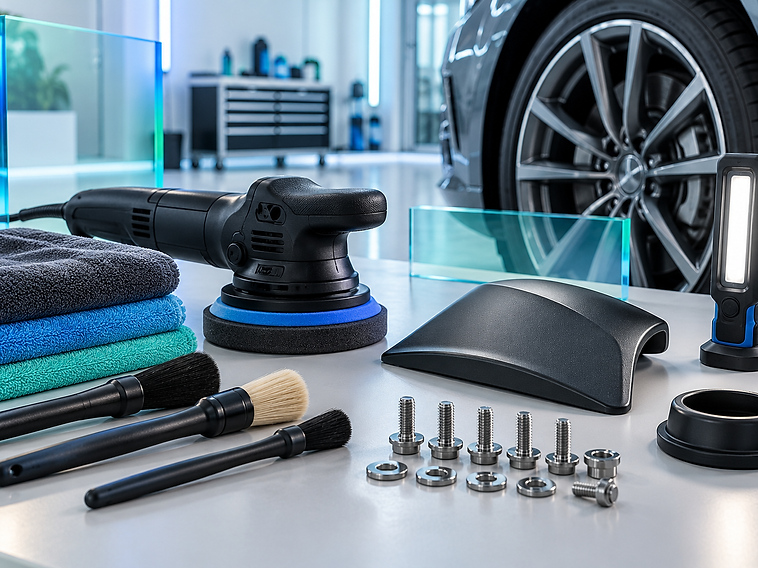
The plastics, rubber, metals, coatings, adhesives, and textiles in a finished automotive product can matter just as much as the formula in a bottle. A detailing brush, polisher, molded trim accessory, work light, or maintenance tool needs a review suited to its materials and intended use.
We help automotive businesses organize supplier declarations, material information, test reports, warning content, instructions, and product claims. For vehicle equipment and aftermarket components, we identify the applicable regulatory questions and the technical evidence or specialist testing needed.
Our review can cover detailing tools, microfiber towels, polishing pads, applicators, brushes, sprayers, storage accessories, garage equipment, molded components, electrical accessories, and battery-powered products. Fitment, electrical ratings, installation instructions, and performance statements should reflect the actual product.

Material and restricted substances
Material and restricted-substance screening, including exposure-based Prop 65 evaluation where relevant.
Warnings and instructions
Product warnings, installation guidance, manuals, safe-use instructions, and traceability records.
NHTSA, CPSC, and electrical rules
Applicability research for NHTSA vehicle equipment rules, CPSC requirements, and electrical or wireless rules.
Testing and recall readiness
Testing needs, recall preparedness, and emissions or tampering questions for relevant aftermarket products.
Packaging, Transport, and Market Access
Know What Changes Before You Ship or Enter a New Market
Selling the same product in a different container, shipping by air instead of ground, or adding a new country can change the review. Aerosols, flammable liquids, corrosive cleaners, and lithium-battery accessories deserve particular attention before a carrier or warehouse receives them.
We help review product shipping information, packaging, carton markings, documentation, and the requirements tied to your route and sales markets. The actual shipment matters: package size, quantity, transport mode, and any available exception must be assessed together.
For U.S., Canadian, and other market expansions within the agreed scope, we map relevant chemical, labeling, warning, language, inventory, and product requirements. Retailer and marketplace documentation requests are tracked alongside the underlying regulations.


Hazmat classification and Section 14
Hazmat classification research and consistency checks for SDS Section 14 and supporting information.
Markings, papers, and carriers
Review of applicable package markings, labels, shipping papers, and carrier acceptance conditions.
Market-specific requirements
Market-specific checks for OSHA HazCom, Canadian WHMIS, EU REACH and CLP, and state requirements.
Documentation coordination
Coordination of documentation for distributors, retailers, warehouses, and fulfillment partners.
Marketing and Claims Review
Support the Claims That Sell Your Automotive Products
Your claims appear everywhere: on the bottle, in a distributor catalog, on a product page, in an influencer video, and at a trade show. We help you evaluate whether the evidence supports the message a buyer is likely to take away.
Common review topics include “non-toxic,” “eco-friendly,” “biodegradable,” “VOC compliant,” “PFAS-free,” “safe on all surfaces,” “scratch-resistant,” “9H hardness,” “five-year protection,” and “Made in USA.” We look at the test method, product conditions, limitations, and the way the claim is presented.
Disinfecting, sanitizing, or “kills 99.9%” claims require a separate pesticide applicability review. A claim can change the regulatory questions surrounding an otherwise familiar cleaner.


Where the claims appear
Packaging copy, product descriptions, advertisements, demonstrations, and sales presentations.
Claim-to-evidence review
Claim-to-evidence review for durability, surface compatibility, cleaning performance, and environmental statements.
Qualifications and disclosures
Qualifications and disclosures that communicate the boundaries of the supporting evidence.
Consistency across channels
Consistency across labels, websites, marketplace listings, and reseller materials.
Website and Ecommerce Compliance
Review the Digital Shelf Alongside the Physical Product
A bottle can carry the right warning while its product page shows an old label, omits a required online warning, or makes a broader claim than the evidence supports. We review the website and listing experience alongside your product documents and packaging.
For automotive ecommerce stores, distributor catalogs, and marketplace listings, we assess product descriptions, label images, claim language, document access, and warning visibility. We also help identify relevant accessibility, privacy, and consumer-facing disclosure questions for the scope of your review.
When you change a formula, package, warning, or intended use, the update should reach the digital shelf too. We help your team turn findings into a prioritized list of content changes and supporting-document needs.


Details and label artwork
Consistency between online product details, current label artwork, and technical documents.
Online warnings and Prop 65
Applicable online warnings, including California Prop 65 placement when required.
Claims, testimonials, disclosures
Review of advertising claims, testimonials, endorsements, and relevant disclosures.
Accessibility, privacy, sales info
Accessibility review topics, privacy and cookie practices, and customer-facing sales information.
Your Client Workspace
Keep Your Automotive Compliance Work Connected in ComplianceCore™
As your product line grows, the challenge becomes keeping the right information connected to the right SKU and market. ComplianceCore™ gives your team a place to manage products, regulatory documents, project requests, status, and communication with Compounded Compliance.
Use SDS Studio for SDS projects and market versions, LabelLogic for label reviews, and ClaimCheck for marketing claim reviews. RegVault organizes documents and versions; MarketMap supports jurisdiction research; ActionBoard keeps tasks and next steps visible; Compliance Intel provides regulatory updates and insights.
Access depends on your selected plan or module configuration. Our team helps you connect the workspace to the reviews and deliverables your business needs.


Products and records together
Organize products and the SDS, label, and supporting records associated with them.
Requests, status, revisions
Track review requests, project status, revisions, and outstanding actions.
Markets tied to the work
Connect market requirements with the documentation and review work in scope.
Deliverables and communication
Keep completed deliverables and communication accessible to your team.
How We Work
Start With Your Products. Leave With Clear Next Steps.
You do not need to arrive with a complete compliance program. Bring the information you have and the question you need answered: a new launch, a distributor request, a rejected listing, a formula change, or expansion into another market.
We define the review around your products, materials, intended use, sales channels, and destinations. From there, we identify the applicable requirements, evaluate the information available, and explain what needs to be corrected, supported, tested, or developed.
- 1
Define the scope
Products, formulas or materials, target markets, and the business decision ahead.
- 2
Gather the evidence
Current SDSs, labels, packaging, supplier records, test reports, and live listing URLs.
- 3
Review the gaps
Classification, warnings, claims, documentation, testing, and market-specific requirements.
- 4
Plan the work
Agreed deliverables, priorities, responsibilities, and a path for future revisions.


Tell us what you sell, where you sell it, and what you need to resolve.
Automotive Compliance FAQs
No. Under OSHA HazCom, SDS obligations depend on the chemical hazards and the applicable scope and exemptions. Product use and exposure matter; a consumer-use exemption is not a blanket exemption for professional detailing use. Retailers may also request documents under their own policies. We review your specific product and channels before determining the documentation needed.
Compliance Intel
Reading for automotive product teams
Industry Spotlight
Selling Car Care Products on Amazon? Your SDS and Compliance Matter More Than You Think
Amazon requires compliant SDS documents and proper hazmat classification before listing chemical products. Here's what you need to know to avoid listing suspensions.
Read the articleLabeling
OSHA HazCom vs. Consumer Labeling: What Every Chemical Company Needs to Know
Unknowing label designers will inaccurately display warnings or skip them entirely for the sake of saving the design. Here's why that's dangerous and what the regulations actually require.
Read the articleRegulatory & Compliance
Prop 65 in 2026: What Chemical Product Companies Need to Know Now
California's Prop 65 continues to evolve, including new guidance on safe harbor warnings for receipts, shipping labels, and packaging. If you sell to California consumers, this matters.
Read the articleTell Us What You Sell. We Will Help Define the Review.
Share your product types, target markets, and the issue you need to resolve. We will scope the SDS, label, product, shipping, claims, or website work around your business.
Request an Automotive Compliance Review