VOC Regulations for Automotive Chemicals: What Manufacturers Need to Know
By The Compounded Compliance Team
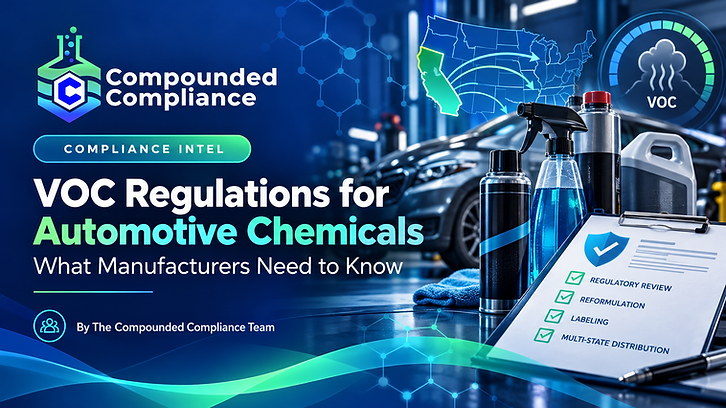
If you manufacture automotive chemical products, you already know about SDSs and GHS labels. But there is another layer of regulation that catches many car care brands off guard: volatile organic compound (VOC) limits. If you plan to sell degreasers, detail sprays, brake cleaners, or other automotive chemicals across multiple states, VOC compliance can determine whether your product is legal on the shelf.
This article explains what VOCs are, how they are regulated, and what automotive chemical manufacturers need to do to stay compliant in every market they sell into.
What Are VOCs and Why Are They Regulated
Volatile organic compounds are carbon-based chemicals that evaporate at room temperature. In automotive chemical products, common VOCs include solvents like isopropyl alcohol, mineral spirits, naphtha, toluene, xylene, and acetone. These solvents are what make degreasers cut through grease, detail sprays flash dry, and brake cleaners dissolve residue.
The problem is that when VOCs evaporate, they react with nitrogen oxides in the atmosphere to form ground-level ozone, also known as smog. Because ozone pollution is a public health concern, federal and state regulators limit how much VOC content a consumer product can contain.
The Environmental Protection Agency (EPA) sets national VOC limits under the Clean Air Act, but individual states can adopt stricter limits. California, through the California Air Resources Board (CARB), has historically led the way with the most stringent VOC limits in the country, and many other states have adopted CARB-style rules or similar standards.
How CARB VOC Limits Work
CARB regulates VOCs in consumer products through its Consumer Products Regulation, which sets maximum VOC content limits by product category. The key concept is that the limit applies to the product category, not to individual ingredients.
For example:
- Brake cleaners have a specific VOC limit, typically lower than general-purpose cleaners
- Engine degreasers have their own category with a distinct limit
- General-purpose cleaners fall under a different category
- Automotive windshield washer fluids are regulated separately
- Carpet and upholstery cleaners may have different limits than hard surface cleaners
The category your product falls into determines the VOC limit that applies. This means that two products with similar formulations may have different compliance obligations depending on how they are categorized. Correct categorization is critical.
If your product exceeds the VOC limit for its category in California, you cannot legally sell it in California without reformulating. And because many states follow CARB's lead, a California compliance failure often means you have a problem in other states too.
States That Go Beyond Federal VOC Limits
The EPA sets a national baseline, but a growing number of states have adopted stricter VOC rules modeled on CARB. These include states in the Ozone Transport Commission (OTC) region, such as:
- New York, New Jersey, Pennsylvania, Virginia, Maryland, and others along the East Coast
- States in the Lake Michigan Air Directors Consortium (LADCO) region
- Individual states that have adopted CARB-aligned rules on their own
If you sell automotive chemical products nationally, you need to know which states have adopted stricter VOC limits and whether your products comply in each one. A product that is legal in Texas may not be legal in California or New York. This is not a labeling issue. It is a formulation issue, and it can block your product from entire markets.
What Happens When a Product Exceeds a VOC Limit
If your product's VOC content exceeds the limit for its category in a regulated state, your options are:
- Reformulate. Reduce the VOC content by switching to lower-VOC solvents or alternative chemistries. This is the most common path, but it requires re-evaluating product performance, hazard classification, SDS, and labeling.
- Reformulate for specific markets. Some manufacturers maintain separate formulations for CARB states and non-CARB states. This adds complexity to inventory management but is a viable strategy.
- Reformulate to the strictest standard. Many brands choose to formulate to the CARB limit for all markets so they only need to manage one SKU. This simplifies distribution but may require trade-offs in product performance.
Regardless of which path you choose, you need documentation. Regulated states can request VOC content data, and you should be able to demonstrate that your product meets the applicable limit for its category.
Practical Steps for VOC Compliance
Here is how to get your arms around VOC compliance for your automotive chemical product line:
- Identify your product categories. Map every product to the correct CARB and EPA consumer product category. If you are unsure which category applies, that is the first question to resolve.
- Test or calculate VOC content. Determine the VOC content of each product using formulation data or lab testing. You need a defensible number, not an estimate.
- Check against state limits. Compare your VOC content to the limits in California and any other regulated states where you sell or plan to sell.
- Flag non-compliant products. Identify any products that exceed the limit for a category in a given state. These are your reformulation priorities.
- Document everything. Keep records of your VOC content calculations, category determinations, and reformulation history. If a regulator asks, you need to be able to respond quickly.
- Plan for new regulations. VOC limits are not static. CARB periodically updates its Consumer Products Regulation with lower limits and new product categories. Stay informed so you are not caught off guard.
How This Connects to SEMA
At SEMA, we expect to see a wave of new automotive chemical products, many of them positioned for national distribution from day one. If those products have not been evaluated for VOC compliance, the manufacturer may be one state expansion away from a compliance problem.
We will be looking at the chemical products on the floor with this question in mind: does this brand know which states their product can legally be sold in? If you are exhibiting and the answer is uncertain, come find us. Our team can help you understand your VOC obligations and what it takes to sell nationally without surprises.
Closing Thoughts
VOC compliance is one of the most overlooked regulatory requirements in the automotive chemical industry. It is not as visible as labeling or SDSs, but it can keep your product off shelves in entire states. The brands that get ahead of it are the ones that can expand into new markets with confidence.
If you need help determining your product categories, calculating VOC content, or planning a reformulation strategy, reach out to the Compounded Compliance team. We will be at SEMA and ready to talk.