
Automotive Hardgoods Compliance: Wiring, Internal Components, and Restricted Substance Requirements
By The Compounded Compliance Automotive Sales Team
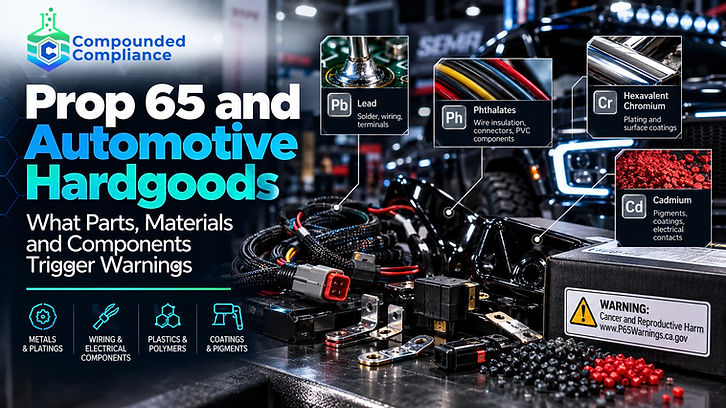
Automotive hardgoods do not always get the same compliance attention as chemicals. If you manufacture or distribute wiring harnesses, electrical components, lighting, performance parts, or interior accessories, you might assume that SDS and chemical labeling rules do not apply to you. In many cases, you are right. But that does not mean you are off the hook.
Automotive hardgoods carry their own compliance obligations, from restricted substance testing to Prop 65 warnings to documentation that proves your materials meet the standards of the markets where they are sold. This article covers the key compliance areas for automotive hardgoods manufacturers, with a focus on wiring and internal components.
Prop 65 and Automotive Hardgoods
California's Proposition 65 requires businesses to provide a clear and reasonable warning before exposing anyone in California to a chemical known to the state to cause cancer or reproductive harm. For automotive hardgoods, the most common Prop 65 concerns involve:
- Lead and lead compounds found in solder, wiring, terminals, and metal components
- Phthalates used as plasticizers in wire insulation, connectors, and PVC components
- Hexavalent chromium used in plating and surface coatings on metal parts
- Cadmium found in some pigments, coatings, and electrical contacts
If your product contains any of these substances above safe harbor levels, you must provide a Prop 65 warning on the product or its packaging when sold in California. The warning must be clear, specific, and formatted according to current OEHHA regulations.
Many automotive hardgoods brands do not realize they need Prop 65 warnings until a notice of violation arrives. At SEMA, we frequently see products on the floor that are sold nationally but lack Prop 65 labeling. If you sell into California, this is a gap you need to close.
Restricted Substance Compliance: RoHS and REACH
If you sell automotive hardgoods internationally, restricted substance regulations add another layer.
RoHS (Restriction of Hazardous Substances) limits the use of certain hazardous substances in electrical and electronic equipment. If your product includes wiring, circuit boards, sensors, lighting, or any electronic component, RoHS may apply. The restricted substances include:
- Lead
- Mercury
- Cadmium
- Hexavalent chromium
- Polybrominated biphenyls (PBBs)
- Polybrominated diphenyl ethers (PBDEs)
- Four phthalates added in more recent revisions
REACH (Registration, Evaluation, Authorization and Restriction of Chemicals) is the European Union's broader chemical regulation. If your product contains substances of very high concern (SVHCs) above certain thresholds, you may have obligations to notify customers or regulators.
Even if you only sell domestically, major retailers and automakers increasingly require RoHS and REACH compliance documentation as a condition of doing business. If you cannot provide it, you may lose the contract.
CPSIA and Lead Testing for Consumer Products
The Consumer Product Safety Improvement Act (CPSIA) sets strict limits on lead content and phthalates in children's products. While most automotive hardgoods are not children's products, the law matters if your product could plausibly be handled by children or is marketed in a way that blurs that line.
More importantly, CPSIA established a framework for third-party testing and certification that many retailers now expect for a broader range of consumer products. If a big-box retailer or e-commerce platform asks for a General Conformity Certificate (GCC), you need to know what that is and how to produce one.
Wiring and Electrical Component Documentation
Wiring and internal electrical components deserve special attention because they intersect multiple compliance frameworks at once:
- Material declarations. You may need to provide a material declaration or full substance disclosure for wiring harnesses, connectors, and circuit boards. This documents exactly what is in the product down to the substance level.
- Flammability ratings. Wire insulation and connector materials often need to meet specific flammability standards. Documentation of compliance with standards like UL 94 or FMVSS 302 may be required.
- Conflict minerals. If your product contains tantalum, tin, tungsten, or gold, you may have reporting obligations under the Dodd-Frank Section 1502 conflict minerals rule.
- Labeling. Wire and cable products may need specific labeling, including voltage ratings, temperature ratings, and certified marks depending on the market.
If you manufacture or import wiring, sensors, lighting, or electronic modules, your compliance file should include material declarations, test reports, and certifications for every SKU.
Practical Steps for Hardgoods Compliance
If you are an automotive hardgoods manufacturer, here is where to start:
- Inventory your products and materials. List every SKU and identify the materials and substances it contains. For wiring and electrical components, this means going down to the polymer, metal, and coating level.
- Assess Prop 65 exposure. Determine whether your products contain listed chemicals above safe harbor levels and add warnings where needed.
- Check RoHS and REACH obligations. If you sell internationally or to major retailers, confirm whether your products are RoHS-compliant and whether any SVHCs are present.
- Gather test reports. Collect third-party test reports for lead, phthalates, flammability, and any other requirements that apply to your product type.
- Prepare certifications. If retailers or regulators require a GCC, RoHS declaration, or material declaration, have them ready before you are asked.
- Centralize your documentation. Use a system like Compliance Core to keep test reports, declarations, and certifications organized and accessible.
What We Are Looking For at SEMA
At the show, we will be paying close attention to hardgoods, especially in the electrical, lighting, and performance parts sections. We want to see how products are labeled, what materials are being used, and whether brands have the compliance documentation to back up their claims.
If you are exhibiting and want to talk through your product line, bring your questions. Whether it is Prop 65, RoHS, CPSIA, or conflict minerals, our team can help you understand what you need and how to get there.
Closing Thoughts
Automotive hardgoods compliance is not as simple as skipping the chemical regulations. It is a different set of rules, but the stakes are just as high. Products that lack restricted substance documentation, Prop 65 warnings, or required certifications can be pulled from shelves, blocked by retailers, or flagged by regulators.
If you make or distribute automotive hardgoods, the time to get your compliance house in order is before you scale, not after. Come find us at SEMA, and we will help you figure out what you need.