GHS Pictograms Explained: A Visual Guide for Car Care Brands
By The Compounded Compliance Chemistry Department

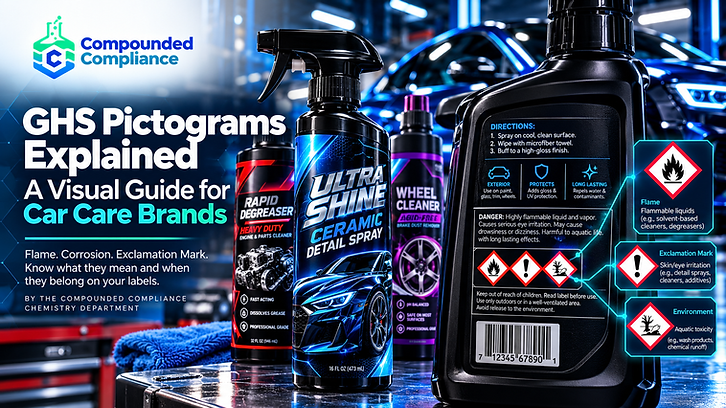
If you manufacture car care products, you know your labels need GHS pictograms. But knowing you need them and knowing which ones to use are two different things. Pictograms are the red diamond-shaped symbols that communicate hazard types at a glance. Use the wrong one, and your label is non-compliant. Omit one, and your product could be on the shelf without the warnings the law requires.
This guide explains the nine GHS pictograms, which ones matter most for automotive chemical products, and how to make sure your labels have the right symbols for every product in your line.
How GHS Pictograms Work
Under the OSHA Hazard Communication Standard (29 CFR 1910.1200), pictograms are one of the six required label elements. Each pictogram corresponds to specific hazard classes and categories identified during the hazard classification process. The pictogram you use is determined by the classification, not by choice.
The pictogram is a red square set at a point (diamond shape) with a black symbol on a white background. The red border must be at least 1.8 mm thick for small labels, and the pictogram must be large enough to be clearly visible. A single product label may require multiple pictograms if the product falls under several hazard classes.
Here is what each of the nine GHS pictograms means and where it shows up in car care formulations.
Flame
The flame pictogram is used for products that are flammable, self-reactive, or emit flammable gases. This is one of the most common pictograms in the automotive chemical category.
Hazard classes that trigger the flame pictogram include:
- Flammable liquids (Categories 1 through 4)
- Flammable gases
- Self-heating substances
- Substances that emit flammable gases in contact with water
In car care products, the flame pictogram typically appears on anything containing solvents like isopropyl alcohol, mineral spirits, naphtha, acetone, or denatured alcohol. Detail sprays, degreasers, brake cleaners, fuel additives, and some waxes and polishes commonly fall into this category.
Corrosion
The corrosion pictogram shows test tubes pouring liquid onto a hand and a metal surface. It is used for products that cause skin corrosion, serious eye damage, or corrosion to metals.
Hazard classes include:
- Skin corrosion (Category 1)
- Serious eye damage (Category 1)
- Corrosive to metals (Category 1)
In automotive chemicals, the corrosion pictogram frequently appears on:
- Acidic wheel cleaners with low pH formulations
- Heavy-duty degreasers with high alkalinity
- Battery cleaners and terminal protectors
- Some concentrated all-purpose cleaners
If your product burns skin on contact or damages metal surfaces, this pictogram is required.
Exclamation Mark
The exclamation mark pictogram covers a broad range of less severe hazards. It is one of the most frequently needed pictograms for car care brands because many cleaning products cause skin or eye irritation without being corrosive.
Hazard classes include:
- Acute toxicity (Category 4, oral, dermal, or inhalation)
- Skin irritation (Category 2)
- Eye irritation (Category 2)
- Skin sensitization (Category 1)
- Specific target organ toxicity, single exposure (Category 3)
Common car care products that may require the exclamation mark include mild detail sprays, diluted all-purpose cleaners, interior cleaners, and some glass cleaners. Even if a product is water-based, it can still trigger this pictogram if surfactants or other ingredients cause irritation.
Health Hazard
The health hazard pictogram shows a silhouette with a starburst in the chest. It is used for serious, long-term health effects.
Hazard classes include:
- Carcinogenicity (Categories 1 and 2)
- Reproductive toxicity (Categories 1 and 2)
- Specific target organ toxicity, repeated exposure (Categories 1 and 2)
- Respiratory sensitization (Category 1)
- Aspiration hazard (Category 1)
In automotive chemicals, this pictogram may appear on products containing solvents that cause organ damage with repeated exposure, such as toluene, xylene, or naphtha in high concentrations. Aspiration hazard is relevant for products that could be inhaled into the lungs if swallowed, which is a risk with many hydrocarbon-based solvents.
Skull and Crossbones
The skull and crossbones pictogram is used for products with acute toxicity at the most severe levels. It signals that exposure, even in small amounts, can cause serious harm or death.
Hazard classes include:
- Acute toxicity (Categories 1, 2, and 3, oral, dermal, or inhalation)
This pictogram is less common in consumer car care products but may appear on highly concentrated industrial formulations, professional-grade chemicals, or products containing ingredients with very low lethal dose thresholds.
Environment
The environment pictogram shows a dead tree and a dead fish. It is used for products that are hazardous to aquatic life.
Hazard classes include:
- Hazardous to the aquatic environment, acute (Category 1)
- Hazardous to the aquatic environment, chronic (Categories 1 through 4)
Many automotive chemicals contain ingredients that are toxic to aquatic organisms, including surfactants, solvents, and certain additives. If your product washes into storm drains during use, this pictogram may be required.
Gas Cylinder, Exploding Bomb, and Flame Over Circle
Three pictograms are less common in automotive chemical products but are worth knowing:
- Gas cylinder is used for gases under pressure. It may appear on aerosol products or compressed gas cleaners.
- Exploding bomb is used for explosives and self-reactive substances. Rare in car care, but possible in certain chemical combinations.
- Flame over circle is used for oxidizing substances. It may appear on certain bleaching or oxygen-releasing cleaning products.
If your product line includes aerosols, compressed gas formats, or specialty formulations, check whether any of these pictograms apply.
Combining Pictograms on a Single Label
Many car care products require more than one pictogram. A solvent-based degreaser might be flammable, cause skin irritation, and be toxic to aquatic life, requiring the flame, exclamation mark, and environment pictograms all at once.
When multiple pictograms are needed:
- All applicable pictograms must appear on the label
- Do not pick and choose. The classification determines what is required
- If the skull and crossbones applies, the exclamation mark is not shown for the same hazard route
- If the corrosion pictogram applies for skin corrosion or serious eye damage, the exclamation mark is not shown for the same effect
These precedence rules prevent redundant or contradictory symbols on a single label.
Common Pictogram Mistakes We See
In our work with car care brands, the same pictogram errors come up again and again:
- Using the flame pictogram without the exclamation mark. A product is flammable and also causes skin irritation, but only the flame appears on the label.
- Omitting the environment pictogram. The product contains surfactants that are toxic to aquatic life, but no environmental hazard is shown.
- Using a pictogram that does not match the SDS. The label shows corrosion, but the SDS classifies the product only as an irritant. The label and SDS must be consistent.
- Using a non-GHS symbol. Some brands use custom icons or older warning symbols instead of the standardized red diamond pictograms. Only the official GHS pictograms are compliant.
How to Get Your Pictograms Right
Here is a practical process for ensuring every product has the correct pictograms:
- Complete the hazard classification first. You cannot choose pictograms until you know the hazard classes and categories for your product.
- Map each hazard class to its required pictogram. Use OSHA's classification criteria in Appendix A and Appendix B as your reference.
- Apply the precedence rules. Remove any pictograms that are superseded by a more severe classification for the same effect.
- Verify the label matches the SDS. The pictograms on the label must match the pictograms listed in Section 2 of the SDS.
- Audit your product line. Pull physical samples of every product and confirm the pictograms are present, correct, and legible.
Closing Thoughts
Pictograms are not decoration. They are a regulatory requirement and a critical communication tool that tells anyone handling your product what hazards they face. Getting them right starts with getting your hazard classification right, and ends with a label that is consistent with your SDS.
If you need help classifying your car care products, verifying your pictograms, or auditing your label line for compliance, reach out to the Compounded Compliance chemistry team. We will be at SEMA and ready to walk through your product labels with you.