E-commerce Compliance for Automotive Products: What Amazon and Retailers Require
By The Compounded Compliance Automotive Sales Team
Selling automotive products online used to mean setting up a website and shipping orders. Today, it means navigating compliance requirements imposed by the platforms themselves. Amazon, Walmart Marketplace, eBay, and major auto parts retailers all have their own documentation requirements for chemical products and hardgoods, and they enforce them at the brand level. If you cannot provide the right documents, your listings can be suspended, suppressed, or rejected before you ever make a sale.
This article explains what e-commerce platforms require from automotive product brands, how those requirements connect to existing regulations, and how to stay ahead of platform policy changes that can disrupt your business.
Why Platforms Care About Compliance
E-commerce platforms are not regulators, but they have become de facto compliance gatekeepers. Their reasons are straightforward:
- Liability. Platforms do not want to be held responsible for selling non-compliant or hazardous products to consumers.
- Consumer safety. A product that lacks proper labeling or hazard communication can injure a customer, leading to returns, complaints, and reputational damage.
- Regulatory pressure. Agencies like the CPSC, EPA, and OSHA have increased scrutiny of online sales channels, and platforms respond by tightening their own requirements.
- Brand trust. Platforms compete on the perception that their marketplace is safe and reliable. Non-compliant products undermine that promise.
For automotive brands, this means the platform is often the first compliance checkpoint you encounter, before any government regulator ever sees your product.
What Amazon Requires for Automotive Products
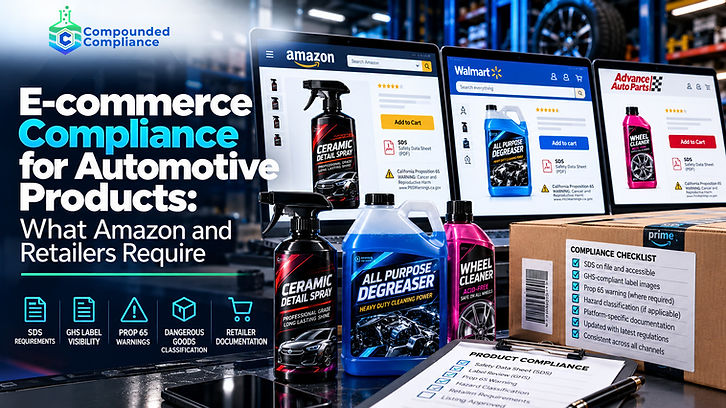
Amazon has the most detailed and most enforced compliance requirements of any e-commerce platform. For automotive chemical products, Amazon requires:
- SDS upload. Any product classified as a hazardous chemical must have a current SDS on file. Amazon reviews the SDS and may flag products that are missing hazard information or contain prohibited ingredients.
- GHS-compliant labeling. Product images must show labels that include all required GHS elements. Amazon may reject listings if the label is illegible or missing pictograms, signal words, or hazard statements.
- Prop 65 warnings. Products sold to California addresses must display a Prop 65 warning on the product page. Amazon has specific formatting requirements for how the warning appears.
- Dangerous goods classification. Flammable liquids, aerosols, and compressed gas products may be classified as dangerous goods for shipping purposes. Amazon requires dangerous goods documentation and may restrict how these products are stored and shipped through FBA.
For automotive hardgoods, Amazon may request:
- General Conformity Certificates (GCCs) for certain consumer products
- Test reports for lead, phthalates, or other restricted substances
- Compliance documentation for products subject to specific safety standards
If Amazon requests documentation and you cannot provide it within their timeline, your listing can be suppressed. Suppressed listings are invisible to shoppers, which means zero sales until the issue is resolved.
What Other Retailers and Marketplaces Require
Amazon is the most visible example, but it is not the only platform with compliance requirements:
- Walmart Marketplace requires SDSs for chemical products and may request compliance documentation during vendor onboarding. Walmart also enforces Prop 65 requirements for products shipped to California.
- eBay has policies restricting the sale of certain hazardous materials and requires sellers to comply with applicable regulations. While enforcement is less systematic than Amazon, violations can result in listing removal or account suspension.
- AutoZone, Advance Auto Parts, O'Reilly, and NAPA require compliance documentation as part of their vendor agreements. These retailers typically ask for SDSs, label artwork, and sometimes Prop 65 assessments before a product is approved for the shelf.
- Big-box retailers like Walmart stores and Target have their own vendor compliance programs that may include restricted substance screenings, testing requirements, and documentation reviews.
The common thread is that every channel expects the brand, not the manufacturer, to provide the documentation. If you are a private label brand, this comes back to the same point we covered in our previous article: your name on the label means your responsibility for the paperwork.
The Compliance Gap That Kills Listings
The most common reason automotive product listings get suspended or rejected is not a formulation problem. It is a documentation problem. Here are the gaps we see most often:
- No SDS on file. The brand has an SDS but never uploaded it to the platform, or the SDS on file is outdated and no longer matches the formulation.
- Label images that do not show GHS elements. The product photo shows the front of the bottle but not the back label where the pictograms and hazard statements appear.
- Missing Prop 65 warning on the product page. The physical product has a warning, but the online listing does not include it, even though the product ships to California.
- No dangerous goods documentation. A flammable product is being shipped through FBA without the required dangerous goods classification, which can trigger a fulfillment block.
- Expired test reports. A retailer requested lead testing three years ago, the report has expired, and no one noticed until the vendor renewal cycle flagged it.
Each of these is preventable, but only if you have a system for tracking what documentation each platform requires and when it needs to be refreshed.
How to Build an E-Commerce Compliance Workflow
If you sell automotive products across multiple online channels, here is how to stay ahead:
- Create a compliance documentation matrix. List every product, every platform or retailer you sell through, and the specific documents each one requires. This is your master tracker.
- Upload SDSs proactively. Do not wait for a platform to ask. Upload current SDSs to every marketplace that requires them, and update them whenever a formulation changes.
- Audit your product images. Make sure your listing photos clearly show the full label, including all GHS elements. If the pictograms are not visible in the image, the platform may assume they are missing.
- Add Prop 65 warnings to every product page. If there is any chance your product contains a listed chemical, add the warning to the online listing. It is easier to include it than to fight a suppression later.
- Classify dangerous goods correctly. If your product is flammable, an aerosol, or contains compressed gas, make sure the dangerous goods classification is on file with every fulfillment platform.
- Set renewal reminders. Test reports, certifications, and some compliance documents expire. Track the expiration dates and start the renewal process 60 days before they lapse.
- Centralize everything. Use Compliance Core or a similar system to store all SDSs, test reports, labels, and certifications in one place so you can respond to any platform request quickly.
How This Connects to SEMA
Many of the brands exhibiting at SEMA are actively expanding their e-commerce presence. They are launching on Amazon, pitching to big-box retailers, or building direct-to-consumer channels. Each of those paths comes with compliance documentation requirements that can stall the launch if they are not prepared.
We will be at SEMA talking to brands about exactly this. If you are planning to expand your online sales and want to understand what documentation you will need, come find us. We can help you map out the requirements for each platform and build a documentation system that keeps your listings live.
Closing Thoughts
E-commerce compliance is not a one-time upload. Platforms update their policies, regulations change, and product formulations evolve. The brands that succeed online are the ones that treat compliance documentation as an ongoing operational requirement, not a launch-day checklist item.
If you need help preparing your product line for Amazon, Walmart Marketplace, or any other online channel, reach out to the Compounded Compliance team. We will be at SEMA and ready to help you get your documentation in order before you list.