What We Are Looking For at SEMA 2026: Automotive Compliance Trends and New Products
By The Compounded Compliance Automotive Sales Team
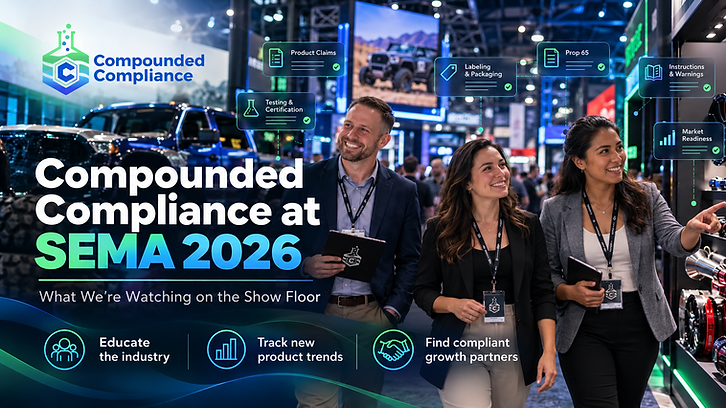
The SEMA Show is the largest gathering of automotive specialty products in the world, and this year, the Compounded Compliance team will be on the floor. From November 3 through 6 at the Las Vegas Convention Center, we will be walking the aisles, meeting with manufacturers and distributors, and looking at the products and trends shaping the automotive aftermarket.
If you are exhibiting or attending, we want to meet you. Here is who we are, what we do, and what we are looking for at the show.
Who Is Attending From Our Team
Three members of the Compounded Compliance team will be at SEMA 2026:
- Our President of Regulatory, who leads the company's regulatory strategy and oversees hazard classification, SDS authorship, and compliance program development for chemical and hardgoods manufacturers.
- Our VP of Automotive Sales, who works directly with automotive product companies to understand their product lines, distribution channels, and compliance pain points.
- Our Senior Project Manager, who coordinates SDS authoring, labeling reviews, and compliance audits from start to finish and ensures that client deliverables meet every applicable standard.
Together, they bring the full picture: regulatory depth, industry relationships, and project execution. Whether your question is about a single product label or a full compliance program across a product line, someone on our team can speak to it.
What Compounded Compliance Does
We help manufacturers, importers, and distributors of chemical products and hardgoods get and stay compliant with the regulations that apply to where their products are sold. That includes:
- SDS authoring and management in the 16-section GHS format
- GHS-compliant labeling with correct hazard classifications, pictograms, signal words, and precautionary statements
- Hazard classification for chemical products across all GHS hazard classes
- Prop 65 compliance for products sold in California
- VOC compliance support for automotive chemical products subject to CARB and state-level regulations
- Hardgoods compliance including CPSIA testing, EPA considerations, and restricted substance screening
- Compliance program development so your team has a written, repeatable system for staying current
Our core platform, Compliance Core, is built to centralize these workflows so that SDSs, labels, and compliance documentation are managed in one place rather than scattered across spreadsheets and email chains.
Why We Are Coming to SEMA
The automotive aftermarket is one of the most dynamic segments we serve. New products launch constantly: ceramic coatings, waterless detail sprays, bio-based degreasers, performance fluids, and innovative hardgoods accessories. Every one of those products carries compliance obligations, and many manufacturers do not realize it until they are already on the shelf or flagged by a retailer.
We are coming to SEMA for three reasons:
1. To educate. We want manufacturers and distributors to understand what compliance looks like for their specific product types. Whether you are formulating a new ceramic coating or importing a line of performance accessories, there are labeling, SDS, and chemical registration requirements that apply. We are happy to talk through what those are, no strings attached.
2. To learn. The show floor is the best place to see where the market is heading. We want to understand what product categories are growing, what new chemistries are being introduced, and what distribution channels are expanding. That helps us anticipate the compliance questions our clients will face next.
3. To find partners. If you are a manufacturer, importer, or distributor who wants to make sure your products meet legal standards wherever they are sold, we want to talk. We are looking for companies that see compliance as a competitive advantage rather than a burden, and we are ready to help build that out.
What We Will Be Looking For on the Show Floor
As we walk the halls at SEMA, here is what we will be paying attention to:
- New automotive chemical products. Detail sprays, coatings, degreasers, fuel additives, and performance fluids. We want to see what chemistries are trending and how they are being positioned.
- Hardgoods and accessories. Tools, lighting, performance parts, and packaging. Each of these has its own compliance considerations, from Prop 65 labeling to restricted substance compliance.
- Private label and white-label products. Many SEMA exhibitors are rebranding or distributing products manufactured by others. If that is you, the compliance responsibility may still fall on you, and we can help clarify where.
- E-commerce and retail expansion. More automotive brands are selling through Amazon, big-box retailers, and direct-to-consumer channels. Each channel has its own compliance documentation requirements, and gaps there can block listings or trigger delisting.
- International distribution. If you are exporting automotive products to Canada, the EU, or elsewhere, the hazard communication and labeling requirements change. We want to talk to companies navigating that.
Common Compliance Gaps We See in Automotive Products
When we walk trade show floors, we often spot the same issues on product packaging and labels. These are the ones we will be watching for:
- Missing GHS pictograms on chemical product labels. A detail spray in a spray bottle without the corrosive or flammable pictogram is a red flag.
- SDSs that do not match the current formulation. A product was reformulated but the SDS still references the old ingredients.
- No Prop 65 warning on products sold in California. If your product contains a listed chemical and you sell into California without the warning, you are exposed.
- Hardgoods without required testing documentation. CPSIA, lead, and phthalate testing applies to certain consumer products, and the documentation needs to be available.
- VOC levels that exceed state limits. A degreaser formulated for one state may not comply with CARB limits or other state VOC rules.
These are exactly the kinds of issues we help companies catch and fix before they become costly problems.
Let's Connect at SEMA
If you will be at the show and want to talk compliance, product classification, SDS authoring, or labeling, we would love to meet. Whether you have a specific question about a product line or just want to understand what your obligations are, we are happy to have the conversation.
We will be walking the floor all four days. Reach out before the show to schedule a time, or flag us down when you see us. We are easy to spot: we are the ones reading the back of the label before looking at the product.