Private Label and White Label Automotive Products: Who Bears the Compliance Burden
By The Compounded Compliance Automotive Sales Team
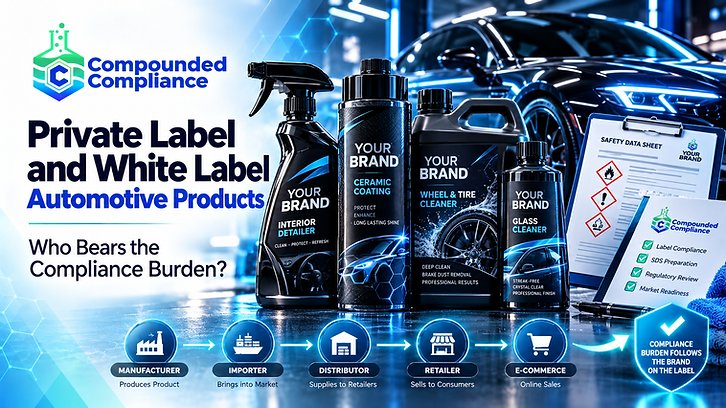
In the automotive aftermarket, not every brand on the shelf is the brand that made the product. Private label and white label arrangements are everywhere. A distributor puts its logo on a detail spray manufactured by a contract compounder. An e-commerce brand sources wheel cleaners from an overseas supplier and rebrands them for the US market. A performance parts company licenses a wiring harness design from a manufacturer and sells it under its own name.
These arrangements make good business sense. They let brands expand their product lines without investing in manufacturing capacity. But they create a compliance question that too few brands answer correctly: when your name is on the label, whose responsibility is the SDS, the GHS labeling, the Prop 65 warning, and the restricted substance documentation?
This article breaks down how compliance obligations flow through private label and white label relationships in the automotive market, and what you need to do to protect your brand.
The Short Answer: Your Name, Your Responsibility
Under the OSHA Hazard Communication Standard, the "responsible party" on a chemical product label is the manufacturer, importer, or distributor whose name appears on the label. If you are the brand whose name is on the product, you are the responsible party. That means:
- You are responsible for ensuring the product has been correctly classified for hazards
- You are responsible for providing a safety data sheet
- You are responsible for the label containing all six required GHS elements
- You are responsible for Prop 65 warnings if the product is sold in California
The fact that someone else manufactured the product does not transfer the compliance obligation away from you. If your name is on the label, regulators, retailers, and plaintiffs' attorneys will come to you first.
For hardgoods, the same principle applies. If you import or distribute a product under your brand name, you are the point of contact for Prop 65, CPSIA, RoHS, and any other applicable compliance requirements. Your contract manufacturer may have produced the product, but you are the one selling it into the US market.
Manufacturer vs. Importer vs. Distributor: Who Owes What
OSHA defines three roles under HazCom, and each carries different obligations:
Chemical manufacturers must classify the hazards of the chemicals they produce, prepare SDSs, and ensure that containers are labeled before the product leaves their facility.
Importers must ensure that the chemicals they import have been classified by the foreign manufacturer, that SDSs are available, and that containers are labeled. If the foreign manufacturer has not provided an SDS that meets US requirements, the importer must prepare one.
Distributors must ensure that containers are labeled and that SDSs are transmitted to downstream customers. Distributors are not required to reclassify products or author new SDSs, but they must pass along the documentation they receive.
In a private label arrangement, you may be acting as the importer, the distributor, or both. If you are sourcing product from overseas and putting your brand name on it, you are likely the importer. If you are buying finished product from a domestic manufacturer and rebranding it, you may still be the responsible party on the label even if the original manufacturer authored the SDS.
What Retailers and E-Commerce Platforms Require
The compliance burden does not stop with OSHA. Major retailers and e-commerce platforms have their own requirements, and they enforce them at the brand level:
- Amazon requires SDSs for chemical products and may request compliance documentation for hardgoods. The documentation must come from the brand listed on the product.
- Big-box retailers like AutoZone, Advance Auto Parts, and Walmart require compliance documentation as part of their vendor onboarding process. If you cannot provide a current SDS, a compliant label, or a Prop 65 assessment, you may not get on the shelf.
- Direct-to-consumer channels are not exempt. If you sell through your own website and ship to California, Prop 65 still applies.
The retailer does not care who compounded the formula or who molded the part. They care about the brand name on the product, because that is who they have a relationship with and who they will hold accountable.
How to Set Up Your Contract Manufacturing Agreement
If you are entering a private label or white label arrangement, compliance documentation should be part of the contract from day one. Here is what to include:
- SDS authoring responsibility. Specify who will author the SDS and whether it will list your company as the responsible party. If the contract manufacturer authors the SDS, make sure it is updated whenever the formulation changes.
- Label artwork and GHS elements. Confirm who is responsible for the label design and ensure all six required GHS elements are included before the product ships.
- Prop 65 assessment. Require the manufacturer to disclose whether any Prop 65-listed chemicals are present in the product and at what levels. If they cannot answer this, that is a red flag.
- Restricted substance documentation. For hardgoods, require material declarations, test reports, and certifications (RoHS, REACH, CPSIA) as part of the deliverables.
- Formulation change notification. Require written notice before any change to the formulation, materials, or manufacturing process. You need to know before the product ships, not after.
- Right to audit. Include a clause that allows you to request updated documentation at any time, especially if regulations change.
Without these provisions, you are trusting that your contract manufacturer is keeping up with compliance on your behalf. That trust is often misplaced.
What to Do If You Are Already Selling Private Label Products
If you already have private label or white label products on the market and have not reviewed your compliance file, here is how to catch up:
- Inventory your products. List every SKU you sell under your brand name, including the source manufacturer and the date of the last SDS or compliance review.
- Request current documentation. Ask each contract manufacturer for the latest SDS, label artwork, Prop 65 assessment, and any applicable test reports.
- Review for gaps. Compare what you receive against the current regulatory requirements. If the SDS is outdated, the label is missing pictograms, or there is no Prop 65 assessment, those are your priorities.
- Fill the gaps. Work with your manufacturer or a compliance partner to update documentation and correct labeling before a retailer or regulator asks for it.
- Centralize everything. Store all compliance documentation in one place, like Compliance Core, so you can respond to retailer requests quickly and track when updates are due.
How This Connects to SEMA
At SEMA, a significant percentage of exhibitors are private label brands, distributors, or white label resellers. Many of them do not have a clear picture of where their compliance documentation lives or whether it is current. If the contract manufacturer goes silent, changes a formulation, or goes out of business, the brand is left holding the bag.
We will be at SEMA looking for brands that are in exactly this situation. If you are selling private label automotive products and want to understand your compliance obligations, come talk to us. We can help you assess what you have, identify what is missing, and build a process that keeps your brand protected as you grow.
Closing Thoughts
Private label and white label arrangements are a smart way to grow an automotive brand, but they shift the compliance burden directly onto you. The brand name on the label is the name that regulators, retailers, and consumers will hold accountable. Make sure you have the documentation to back it up.
If you need help auditing your private label product line, setting up compliance terms with your contract manufacturers, or building a documentation system that scales, reach out to the Compounded Compliance team. We will be at SEMA and ready to talk.